
Most people book an eye exam for one reason. Their glasses stopped working the way they used to. That is a perfectly good reason to go, and it is also the smallest part of what happens once you sit down in the chair.
A comprehensive eye exam is a health screening that happens to end with a prescription. The eye is the only place in the body where a clinician can look directly at blood vessels and nerve tissue without making an incision. Problems that eventually announce themselves elsewhere often appear here first, quietly, years ahead of any symptom you would notice on Your Own.
Table of Contents
The Exam Starts With Questions, Not Equipment
Before any lens goes in front of your face, a good optometrist asks about your medications, both prescribed and over the counter, your personal health history, and your family’s eye history. This is not paperwork for the sake of paperwork. Some blood pressure and allergy medications reduce tear production. A parent with glaucoma changes how closely your optic nerve gets watched. Diabetes changes the risk profile of the entire appointment.
That intake shapes everything that follows. Two patients with identical vision can need very different exams.
What Actually Gets Measured
The refraction, the part where you compare lens one against lens two, produces your prescription. It takes a few minutes and it is the part patients remember. The rest of the exam is doing quieter work.
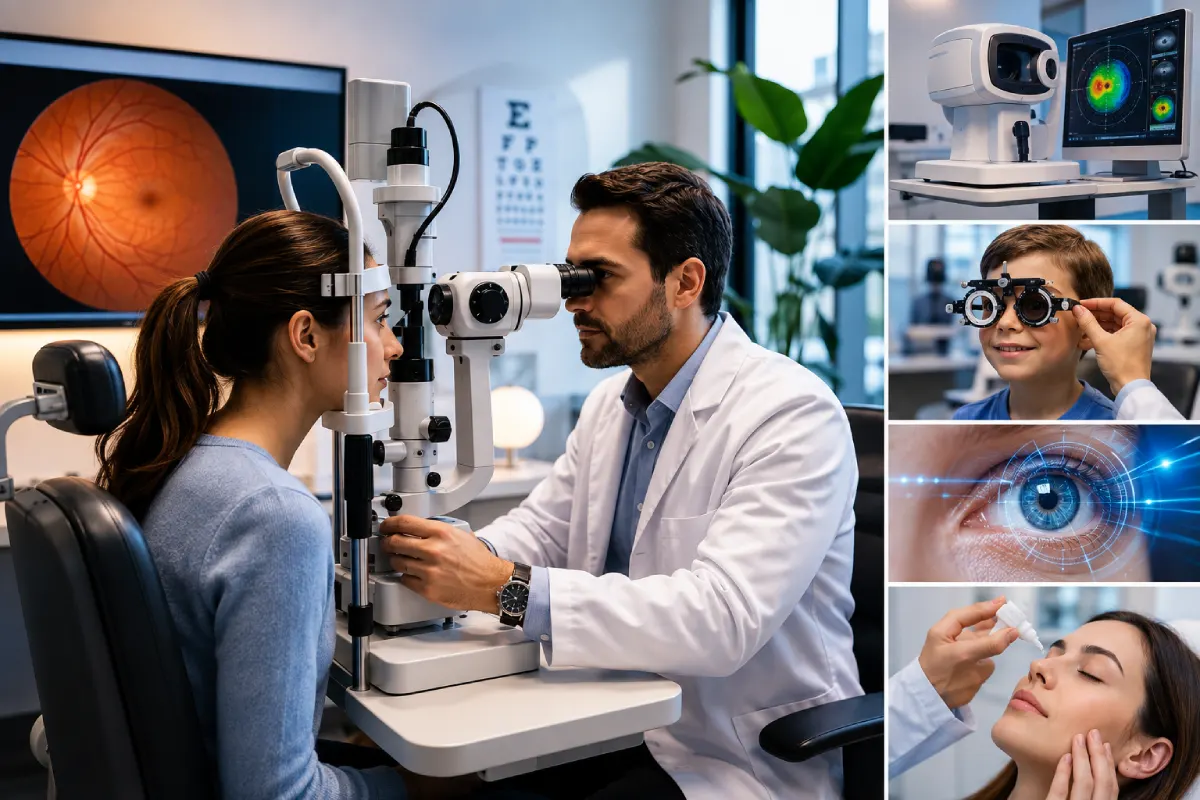
Your optometrist checks how your eyes move and focus together, because headaches and reading fatigue frequently come from a teaming problem rather than a blurry one. Intraocular pressure gets measured because elevated pressure is the main modifiable risk factor in glaucoma, a disease that takes peripheral vision first and is usually painless until the damage is permanent. A dilated or wide-field look at the retina can reveal macular degeneration, retinal tears, and the early vascular changes caused by diabetes and high blood pressure. Cataracts get graded long before they are worth removing, which gives you a timeline instead of a surprise.
None of this produces a dramatic moment. It produces a baseline. The value of a baseline is that next year’s images can be compared against it, and change is what clinicians act on.
Symptoms Deserve Their Own Track
Not every complaint is a refractive one. Burning, watering, grittiness, and the sensation that something is stuck in your eye usually point to a tear film problem rather than a focusing problem. The tear film has three layers, including an outer oil layer that keeps tears from evaporating off the surface too quickly. A shortage in any one of them leaves the eye exposed and irritated, and it is the leading reason people quit contact lenses entirely, often concluding that their eyes simply cannot tolerate them.
That conclusion is frequently wrong. A dedicated dry eye evaluation identifies which layer is failing and why, which is what makes it possible to find the best contacts for dry eyes instead of abandoning lenses altogether. Material, replacement schedule, and daily wear time all become solvable variables once the underlying cause is understood.
Children Need Exams Earlier Than Most Parents Expect
Children rarely report vision problems, because they have no reference point for normal. They assume everyone sees what they see. Pediatric exams can begin in infancy, and early detection matters most for conditions where the visual system is still developing. Myopia is the clearest example. Progression in children and teens can now be slowed with specific treatment options rather than simply corrected with a stronger prescription every year.
Walking Out With Your Glasses The Same Day
The gap between the exam and the eyewear is the part patients like least, particularly when the appointment was prompted by a lost or broken pair. Practices with an on-site finishing lab can cut and fit select single vision prescriptions while you wait, sometimes in around twenty minutes. Multifocals still require lab time, so confirm that before you plan your day around it. If you are searching for Milwaukee same day glasses, ask specifically whether the lab is in the building rather than off site.
Booking The Appointment
One appointment a year tells you something about your health that nothing else in your routine will. Looking for an eye care specialist Milwaukee residents actually recommend? 414 Eyes is an independently owned practice serving Milwaukee, Wauwatosa, West Allis, Greenfield, Oak Creek, Brookfield, Franklin, and Glendale, with comprehensive exams, contact lens fittings, dry eye care, and same day glasses under one roof.