
Table of Contents
What is ADHD? (Symptoms in Adults and Children)
ADHD – A mental health disease known as Attention Deficit Hyperactivity Disorder (ADHD) can cause abnormally high levels of hyperactivity and impulsive conduct. Additionally, people with Attention Deficit Hyperactivity Disorder may have trouble focusing on a task or staying still for extended periods.
Many people suffer from inattentiveness and changes in their energy levels. In people with Attention Deficit Hyperactivity Disorder, this happens more often and more often than in people without the disorder. This can significantly impact their school, work, and family life.
Both adults and children can have ADHD. It is a diagnosis recognized by the American Psychiatric Association (APA). Discover the types and symptoms of Attention Deficit Hyperactivity Disorder in children and adults.
ADHD Overview
| Factor | Details |
| Condition Type | Neurodevelopmental disorder |
| Common Age | Starts in childhood, can continue in adults |
| Main Symptoms | Inattention, hyperactivity, impulsivity |
| Affected Areas | Brain function, behavior, focus |
| Diagnosis Method | Behavioral evaluation, checklists |
| Treatment | Therapy, medication, lifestyle changes |
ADHD Symptoms
A variety of behaviors are associated with ADHD. Some of the most common are:
- Having trouble concentrating or concentrating on a task
- Forgetting to complete tasks
- Easily distracted
- Difficulty sitting still
- Interrupt while people are talking
Signs and symptoms can vary for different aspects of ADHD, such as hyperactivity, impulsiveness, or difficulty concentrating.
- People who suffer from hyperactivity and impulsivity may:
- For example, you find sitting still or staying seated in class difficult.
- I find it difficult to play quietly or to work.
- Talk too much
- It’s hard to wait your turn
- Interfering with other people talking, playing, or performing tasks
People who have difficulty concentrating may:
- Frequent mistakes or missing details when studying or working
- Difficulty staying focused when listening, reading, or speaking.
- I find it challenging to organize my daily tasks.
- Often lose things.
- I am easily distracted by the little things that happen around me.
You or your kid may experience any or all of these symptoms if you or they have Attention Deficit Hyperactivity Disorder . The type of ADHD you have will determine the symptoms you experience. Check out our list of typical ADHD symptoms in kids.
ADHD Symptoms in Adults vs Children
| Symptom Area | Children | Adults |
| Attention | Easily distracted, forget homework | Difficulty focusing, forget tasks |
| Hyperactivity | Running, climbing, can’t sit still | Restlessness, feeling mentally overloaded |
| Impulsivity | Interrupting others, acting quickly | Impulsive decisions, impatience |
| Organization | Messy schoolwork, forget assignments | Poor time management, disorganized work |
| Emotional Control | Tantrums, frustration | Stress, mood swings |
ADHD Symptoms Checklist
Here is a simple checklist to understand common ADHD signs:
- Trouble focusing on tasks
- Easily distracted
- Forgetting daily activities
- Difficulty staying organized
- Restlessness or constant movement
- Talking excessively
- Interrupting others
- Difficulty completing tasks
Types of ADHD
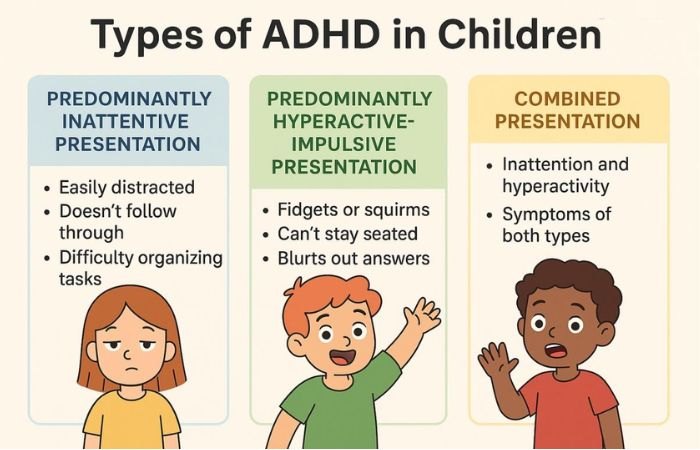
To make the diagnosis of ADHD more consistent, the APA has classified the conditions into three categories or types. These types are primarily inattentive, mostly hyper-impulsive, and a combination of the two.
Mostly Careless
As the name implies, those with this Attention Deficit Hyperactivity Disorder have difficulty focusing, finishing work, and following directions.
Because they don’t frequently interrupt class, experts think that many kids with the inattentive form of ADHD may not receive a correct diagnosis. However, according to research from a reliable source, this is more typical among ADHD girls.
Hyperactivity – The Dominant Type Of Impulsivity
People with this type of ADHD are primarily hyperactive and impulsive. These may include:
- Hustle
- Interrupt while people are talking
- I can’t wait my turn
People with a preponderance of hyperactive-impulsive ADHD may still have trouble focusing on tasks, even if inattention is less of a worry in this kind of Attention Deficit Hyperactivity Disorder.
Complex Hyperactivity, Impulsivity, And Inattention
The most typical kind of ADHD is this one. Both attention deficit and hyperactivity symptoms are present in those with this mixed form of Attention Deficit Hyperactivity Disorder. These include impulsivity, inattentiveness, and excessive activity and energy.
Your child’s or your therapy will depend on the type of ADHD they have. Your treatment plan might alter as your kind does throughout time.
ADHD is divided into inattentive, hyperactive-impulsive, and combined types
What Brings On Attention Deficit Hyperactivity Disorder?
Despite how widespread ADHD is, medical professionals and researchers are still unsure of its root cause. It’s believed to have neurological roots. However, genetics may also be essential.
This shows that a drop in dopamine levels may cause ADHD. A chemical called dopamine aids in the transmission of signals from one nerve to another in the brain. It contributes to the onset of emotional responses and behaviors.
The other postulates variations in brain structure. People with Attention Deficit Hyperactivity Disorder have a less gray matter, according to studies. The brain’s gray matter has regions that support:
- Speech
- Continence
- Decision
- Muscle control
Researchers are still investigating potential causes of Attention Deficit Hyperactivity Disorder, such as smoking during pregnancy. Learn more about possible causes and risk factors for ADHD.
Test and Diagnosis of ADHD
- There is no single test to confirm ADHD in children or adults.
- Doctors usually look at symptoms over time, not just one test result.
- They check behaviors from the last 6 months to understand patterns.
- Information may be collected from:
- Parents
- Teachers
- Family members
- Doctors often use simple checklists and rating scales to assess symptoms.
- A basic physical check-up may also be done to rule out other health problems.
- If you think you or your child may have ADHD, it’s important to consult a doctor.
- For children, teachers or school counselors can also help identify early signs.
- Sharing real-life behavior (at home, school, or work) helps in better diagnosis.
- In some cases, the doctor may refer you to a specialist, such as:
- Psychologist
- Psychiatrist
- Neurologist
- According to the Centers for Disease Control and Prevention (CDC), ADHD can affect both children and adults, and proper evaluation is important for an accurate diagnosis.
Latest Updates in ADHD
Recent research has improved how ADHD is understood and treated.
- Early diagnosis in adults is increasing
- Digital tools and apps help track symptoms
- Behavioral therapy is more personalized
- Awareness about adult ADHD is growing globally
Latest ADHD Trends
| Area | Latest Insights |
| Diagnosis | Increase in adult ADHD diagnosis |
| Technology | Apps and tools for tracking symptoms |
| Therapy | More personalized behavioral therapy |
| Awareness | Growing global awareness of adult ADHD |
Attention Deficit Hyperactivity Disorder Treatment
ADHD treatment usually includes behavioral therapy, medication, or both.
Types of treatment include psychotherapy or talk therapy. In talk therapy, you or your child will discuss how Attention Deficit Hyperactivity Disorder affects your life and how it can help you manage it.
The use of behavioral therapy is another form of treatment. With this therapy, you or your child can learn to keep an eye on and control their behavior.
When dealing with Attention Deficit Hyperactivity Disorder, medications can be pretty beneficial. Medication for ADHD is intended to alter brain chemistry to improve your ability to regulate impulses and behavior.
ADHD Treatment Overview
| Treatment Type | Description |
| Behavioral Therapy | Helps manage behavior and improve focus |
| Medication | Balances brain chemicals for better control |
| Psychotherapy | Talk therapy to manage emotions and challenges |
| Lifestyle Changes | Routine, sleep, diet, and time management |
Advice on Managing ADHD
A steady routine built on predictable structure and expectations might be beneficial if you or your kid has ADHD. Here is some organizational advice for adults:
- Create a list
- keep the schedule
- Reminder settings
For children, it can be helpful to write down homework and focus on storing everyday items such as toys and backpacks in designated places.
You can learn how to handle your impairment by being more knowledgeable about it. Organizations like the Attention Deficit Disorder Association provide information on management and the most recent research, as well as on children and adults with ADHD.
You can get further guidance on managing your Attention Deficit Hyperactivity Disorder symptoms from your doctor. The following advice can assist your child with ADHD.
You can also explore our detailed guide on mental health advice here: mental health tips
Conclusion
For children and adults, if ADHD is left untreated, it can seriously affect their lives. It can affect school, work, and relationships. Therefore, treatment is essential to reduce the effects of the disease.
It is always important to remember that many people with ADHD enjoy a sense of fulfillment and successful life. Some people even enjoy the benefits of the condition.
If you think your child has Attention Deficit Hyperactivity Disorder, the first step is to talk to your doctor, if possible. This can help determine if ADHD affects you or your child. Your doctor can help you manage your symptoms and create a treatment plan to help you get along with ADHD.